

Sam Cotterall
Director of Client Enablement | Verse

You worked hard to negotiate your PPA. But once the deal is live, a new set of questions starts to surface. Is your PPA performance where it should be? Why is the budget drifting this month? And when developers point to curtailment, basis risk, or market conditions, how do you know what’s real?
In this webinar, we’ll break down how leading energy teams explain PPA performance in volatile markets without getting lost in models, spreadsheets, or anecdotes. We’ll focus on the signals that matter, the PPA performance questions executives ask, and how to translate complex market behavior into clear, defensible answers for finance, sustainability, and leadership.
This session is designed for teams managing active PPAs who need clarity, not theory. No negotiation tactics. No modeling deep dives. Just a practical framework for understanding, explaining, and defending PPA performance with confidence—and a repeatable system for keeping leadership informed every month.
Watch on-demand to learn how to turn complex PPA performance data into executive-ready answers you can stand behind.

Sam Cotterall
Director of Client Enablement | Verse
As Director of Client Enablement at Verse, Sam Cotterall acts as a cross-functional leader, blending deep product expertise with market knowledge to bridge product, sales, and customer success functions.
Sam joined Verse from Schneider Electric, where he was a manager on the Renewable Energy and Carbon Advisory consulting team. In that capacity, Sam partnered with Fortune 500 companies to design, implement, and optimize global renewable energy strategies. He led clients through complex decision-making processes with a specialization in renewable energy and tax credit procurement in North America.
Prior to Schneider, Sam worked at BloombergNEF to help investors, businesses, and policy makers navigate the energy transition through data and insights.

Amber Lin
Business Operations Manager | Verse
Amber Lin is a Business Operations Manager at Verse, where she works directly with customers to drive smarter, more profitable management of their energy assets through Verse’s software-plus-services platform. She partners closely with product, data science, and engineering teams to deliver actionable insights and operational results about our customer’s energy asset.
Before joining Verse in 2025, Amber spent over five years at Bain & Company, advising large utilities and energy companies on portfolio strategy, capital investment planning, and long-term resource decisions. Her work included supporting major load growth from data centers, evaluating multi-gigawatt battery storage additions, and building billion-dollar investment strategies to improve reliability, cost performance, and financial returns. At Bain, she also led sustainability initiatives focused on carbon offsets and virtual PPAs and regularly collaborated with F500 executives.
Amber holds a degree in Civil & Environmental Engineering from Princeton University, with minors in Energy and Entrepreneurship.
Sam Cotterall: Welcome. Today’s session is focused on post-contract, operational PPAs — specifically on explaining PPA performance — what’s happening with your asset, not on modeling new deals or renegotiating existing ones. Renewable assets generate a lot of data, and the challenge isn’t accessing that data — it’s making sense of it and communicating it clearly to the people who need to understand it, whether that’s your sustainability team, finance, or executive leadership.
Sam Cotterall: We’ll cover who we are at Verse, then walk through a four-pillar framework for explaining PPA performance variance — the system we use to turn raw data into clear, defensible answers. The goal is to give you a system for setting up clear, consistent internal reporting. We’ll close with Q&A.
Sam Cotterall: I’m Sam Cotterall, Director of Client Enablement at Verse. My background is in sustainability consulting — I spent several years as a manager on a carbon advisory and renewable energy team, and before that worked in energy transition research. Joining me today is Amberlin, our Business Operations Manager.
Amberlin: Thanks, Sam. I’ve been at Verse for about eight months, working closely with our customers on analytics and the advisory layer on top of our software. Before Verse, I was at Bain & Company in the utilities group, doing financial and asset procurement modeling for large investor-owned utilities, and I’ve also done executive strategy and leadership reporting work with Fortune 500 companies. So I’m very familiar with how reporting needs to work at the leadership level in large organizations.
Sam Cotterall: Verse is a software-first platform built by energy buyers, for energy buyers. We unify energy data to help organizations plan, forecast, and operate their renewable energy assets — from understanding load and building a renewable glide path, to running discounted cash flow models, going to market, transacting, and managing operational assets through a risk management lens. Our team combines deep energy expertise with a strong technical foundation — PhD data scientists, statisticians, and engineers working on things most of us can’t imagine. Today we’re focused on the energy expertise.
Sam Cotterall: PPA owners are rich in data. The problem is interpretation. Generation meter readings, pricing, availability, curtailment, forward price curves, basis, weather data, settlement mechanics, credit support, environmental attributes, emission factors — all of this is typically scattered across spreadsheets. And none of it answers the questions that actually matter to leadership: Is PPA performance where we expected it to be? Why is our PPA performance above or below budget? Is what the developer is telling us about PPA performance accurate?
Sam Cotterall: To answer those questions, it helps to start with why renewables don’t behave like conventional generation. A thermal plant responds to price signals — when prices are high, it produces more. Renewables don’t dispatch to the market. To generate revenue from a renewable PPA, you need three things to align simultaneously: resource availability, market price, and timing.
Sam Cotterall: Resource availability is straightforward — the sun has to be shining or the wind has to be blowing. Market price matters because a VPPA is a fixed-for-floating arrangement. If you’re generating when the market price is below your strike price, the settlement goes against you. And timing matters in ways that are easy to miss: during Winter Storm Fern, for example, there was significant wind energy demand and prices spiked over $1,000 per megawatt hour at the ERCOT North Hub — but many wind turbines were offline due to icing or cold-temperature shutdowns. The resource was there. The prices were there. The timing wasn’t. That combination explains why PPA performance can’t be reduced to a single factor.
Amberlin: This is exactly why forecasting is so difficult, and why the questions from leadership tend to pile up. When actuals come in and they don’t match the forecast, the instinct is to ask what went wrong. Our goal today is to give you a structured way to explain PPA performance clearly — not just for this month, but as a repeatable system.
Sam Cotterall: Winter Storm Fern is a useful lens for everything we’re going to discuss today, because it happened recently and because it created exactly the kind of volatile, high-stakes situation where explaining PPA performance to leadership breaks down. In a poll of our attendees at the start of this session, roughly 70% said they didn’t yet know whether their asset was generating during the storm or what the financial result looked like — and the storm was already two weeks in the past. That lag is the problem we’re trying to solve.
Amberlin: The typical developer invoice cycle creates a 30-to-45-day lag between when something happens and when you find out about it financially. During that window, leadership is already asking questions. The Verse approach is to close that gap through direct API integration with the asset, pulling near-real-time or one-day-lag revenue meter data. Paired with your contract terms, we can calculate the settlement almost immediately — long before the developer issues the monthly invoice.
Sam Cotterall: To illustrate what this looks like in practice, we modeled two scenarios for a sample 220-megawatt wind asset in ERCOT during the storm. In Scenario A, the asset was iced out and offline during the peak pricing window on January 25th and 26th. It missed price spikes exceeding $1,000 per megawatt hour. The result: zero earnings during the storm period, and a total four-day net settlement of approximately $320,000 — modest, because most of that window was offline. In Scenario B, the asset was generating throughout — even at lower-than-normal output levels, it captured the price peaks and generated approximately $580,000 over the same four-day window.
Sam Cotterall: One important piece of context: January as a whole was trending negative for most PPA offtakers before the storm hit. Unseasonably warm weather had kept gas prices and clearing prices low. The storm’s high-price window partially offset that negative month-to-date position for assets that were online — but for those that weren’t, the month was likely a net loss. Understanding both the storm and the month-to-date context is essential for the conversation with leadership.
Sam Cotterall: With that context in place, let’s walk through the four pillars we use to explain PPA performance variance. These apply whether you’re comparing this month to last year, or actuals to forecast. The pillars are: generation, generation-weighted price (which includes the timing or capture rate component), and contract terms — which we break into its own detailed discussion.
Sam Cotterall: When PPA performance is below expectations, the first question is whether the shortfall was due to the resource or to the asset. These require different explanations and different actions.
Sam Cotterall: For resource availability, we can triangulate weather station data to within about a square mile of the asset and determine actual wind speeds or solar radiation for any given period. We compare that against two benchmarks: what happened in the same period last year, which is useful for year-over-year comparisons that leadership may already be tracking, and the long-term average — typically a 10- or 30-year baseline — which is what most forecasts are built on. If wind was 20% below the long-term average for a given month, that’s a clean, quantifiable explanation that doesn’t require technical fluency to understand.
Amberlin: The 12-month comparison is useful for explaining a specific deviation against a real data point your team has already seen. But the long-term average is more directly tied to how forecasts were constructed. We show both so you can choose the right frame for your audience.
Sam Cotterall: On the operational side — asset-specific performance, degradation, maintenance — we can incorporate that through telemetry data or developer notifications. If the resource was adequate but the asset wasn’t generating, that’s an operational conversation, not a weather conversation. Distinguishing between the two is critical for explaining PPA performance credibly to finance and leadership.
Sam Cotterall: Megawatt-hours are secondary to dollars per megawatt-hour. The around-the-clock average price is only part of the story. What really matters for PPA performance is the price during the hours your specific asset is generating — which is your capture rate.
Sam Cotterall: Market price is driven by a set of well-established explanatory variables. Natural gas price is the most correlated factor across U.S. power markets — gas sets the marginal price in most markets most of the time. Temperature-driven demand, measured through heating and cooling degree days, is the second major driver: as temperature deviates from the roughly 65°F baseline in either direction, electricity demand increases and prices follow. Net demand growth from data centers, industrial electrification, and transportation electrification is reshaping longer-run price expectations in every major market. And there are regional dynamics — congestion, hub-specific transmission constraints, carbon pricing in European markets — that can cause prices at your specific asset location to diverge from the broader hub.
Amberlin: One thing we flag frequently: if market prices are low but gas prices are rising, there’s usually something else going on — congestion, a hub-specific event, or a temporary supply dynamic. We look at those regional factors so we can give an accurate explanation rather than pointing to the wrong driver.
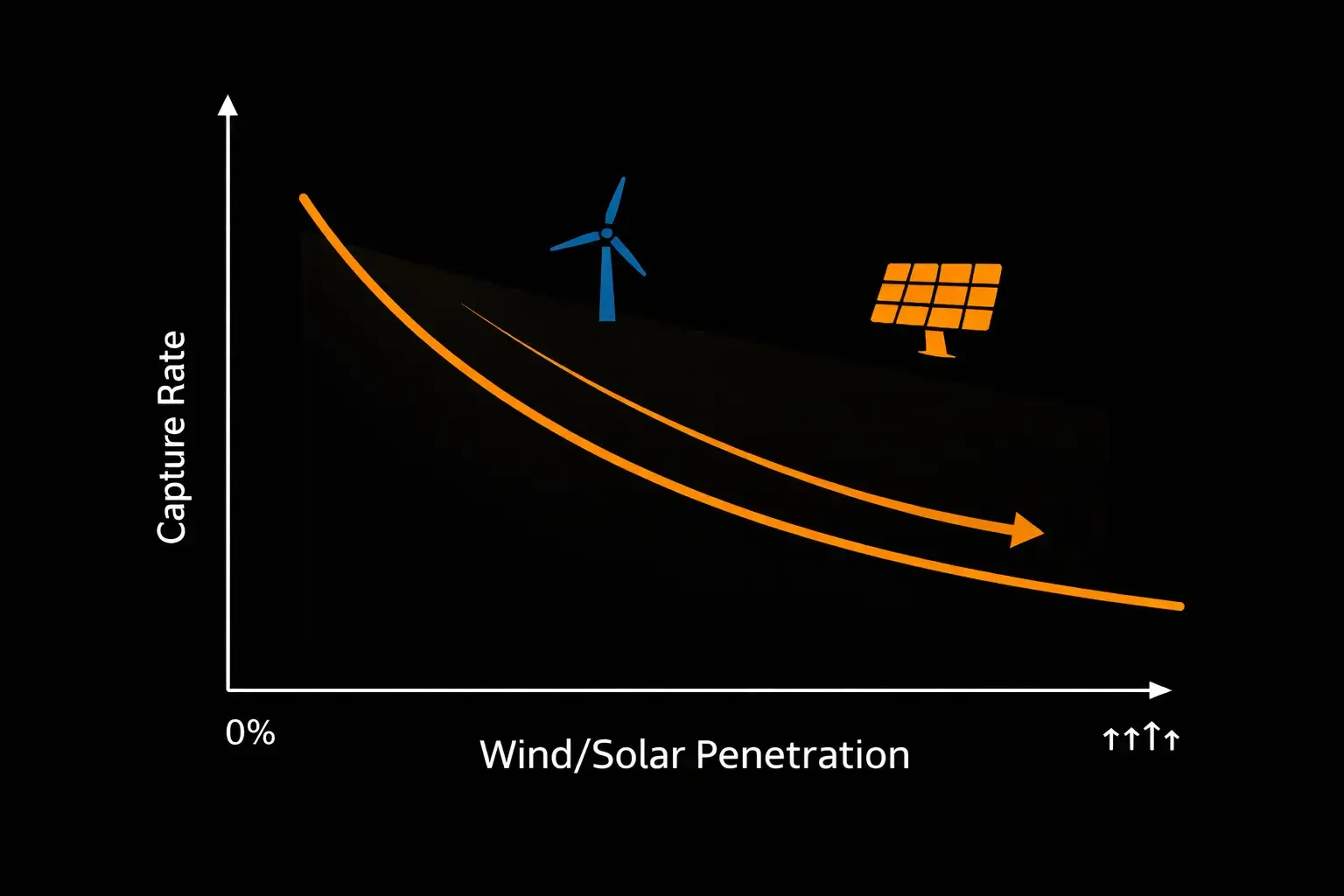
Sam Cotterall: The capture rate — the timing component — is where a lot of hidden value or hidden loss lives. In high-renewable-penetration markets, there is a well-documented cannibalization effect: when wind is blowing strongly across a region, all wind assets generate at the same time. That floods the market, suppresses prices, and can even push them negative. Meanwhile, when wind stops, prices spike — but your wind asset isn’t generating to capture those prices. This is called shape risk, and it compounds over time as renewable penetration increases. We saw this play out in real time in ERCOT’s West Hub during the storm: as wind generation ramped up on January 23rd, real-time prices declined in near-perfect correlation. The same effect is visible with solar in any market with significant solar penetration — as solar ramps up mid-morning, it pushes gas off the dispatch stack and prices fall. This is the merit order effect: power plants are dispatched from lowest to highest marginal cost, and wind and solar — with near-zero marginal costs — always dispatch first.
Sam Cotterall: The practical implication for PPA performance communication: when your capture rate is lower than the average market price, it’s not a malfunction — it’s physics. But you need to be able to explain it that way, and show how it compares to what was expected.
Amberlin: This pillar is about making sure your settlement is being calculated correctly — and it’s one of the most overlooked factors in PPA performance reporting. It matters more than many teams realize, and it’s often undermanaged — either because the contract was negotiated by someone who has since left, or because both parties are applying complex terms for the first time and doing so in isolation.
Amberlin: There are three buckets of contract terms to understand and validate. The first is settlement mechanics: price floors, price ceilings, no-settlement periods when prices go negative, and upside share provisions if the floating price exceeds the fixed price. These are the most straightforward to validate and a good starting point.
Amberlin: The second is basis adjustments. Many contracts include a provision that allows the seller to identify intervals where the difference between the node price — where the asset actually settles — and the hub price exceeds a defined threshold, typically when that spread is larger than the combined value of the fixed price and the production tax credit. The seller can select a defined number of those intervals per contract year to remove from settlement or recalculate using an agreed-upon alternative price. Some contracts are bilateral — if the node price is higher than the hub price, there may be a buyer-side basis adjustment that benefits you as well.
Sam Cotterall: Basis adjustment terms have become more common and more balanced in recent years. Historically, basis risk was placed almost entirely on the seller, and we saw significant negative consequences for sellers in markets like SP Wind. Today, more contracts are structured to share that risk between buyer and seller — which is an important shift in the current sellers’ market. Getting the basis adjustment calculation right can have a tens-of-thousands-of-dollars impact on a single month’s settlement.
Amberlin: The third bucket is availability guarantees. Almost every contract includes a requirement that the seller maintain availability above a minimum threshold — typically between 85% and 95% of eligible intervals. There are two common flavors. The first is mechanical availability: is the inverter or turbine connected to the grid and capable of generating? The second, increasingly common, is production-based or yield-based availability: the contract defines a physical performance model as a benchmark, and actual output is compared to that benchmark. Sellers typically have significant influence over the benchmark model they provide at signing, which is why independent validation is valuable.
Amberlin: To validate an availability report, we look at three categories of intervals: available, excused, and unavailable. The most important — and most nuanced — is the available category. We compare reported available intervals against our own physical model of expected performance. If the asset claims availability but actual generation is materially below what the physical model would predict, that’s a candidate for follow-up with the developer. For excused intervals, the two most common justifications are economic curtailment and weather. We can verify curtailment against system operator notices, which are typically issued at the time of the event, and we can verify weather claims against actual site-level meteorological data. If a developer invokes force majeure for Winter Storm Fern, we can confirm whether the temperature and icing conditions at that specific site actually met the contract’s threshold for an excused outage.
Sam Cotterall: That’s a lot of information — and none of it should go directly to your CFO or sustainability VP every month. The goal of this framework is to give you the tools to summarize PPA performance in a way that’s concise, credible, and consistent every month. In practice, that looks like a single slide that leads with the answer: we were X above or below budget this period. Here’s why — one sentence. Then supporting data that quantifies each of the contributing factors across the four pillars.
Sam Cotterall: The power of a standardized format is that leadership stops asking what happened and starts asking what we do next. When your audience knows what to expect from you each month and the explanation maps to the same framework every time, you build credibility around PPA performance. You’re not scrambling to explain a surprise — you’re confirming what you already knew was coming and helping the organization plan around it.
Sam Cotterall: A few principles that underpin this: contextualize everything — raw wind speeds or watt-hours mean nothing without a comparison to expectations or historical norms. Quantify the PPA performance impact of each factor in dollar terms wherever possible. And use telemetry to close the information gap — near-real-time data from the asset means you’re not discovering PPA performance issues weeks after the fact.
Audience Question: When a developer points to weather as the reason for underperformance, how do you determine whether it’s truly force majeure or an operational issue affecting PPA performance?
Sam Cotterall: A three-step check. First, verify the resource: what were the actual wind speeds, temperatures, and precipitation at the site? Were conditions actually outside the turbine’s operating range? This is data we have independently. Second, check asset availability: if the weather data shows that conditions were within normal operating bounds but the turbines were offline, the issue is operational, not weather-related. Telemetry makes this distinction clear — you can see whether the turbines were generating when the resource was present. Third, check the contract: force majeure has a specific definition in every PPA. Whether the developer was required to issue a formal notice, and whether the conditions met the contractual threshold, is a matter of reading the language against the facts. The question is always: was this unavoidable, or was it avoidable? Act of nature or act of operator.
Audience Question: How close are your real-time revenue estimates to final settlement? Where do you typically see the biggest gaps?
Amberlin: Theoretically, real-time telemetry data should match the final invoice almost exactly, since the revenue meter data is the same data source used to calculate generation and therefore settlement. In practice, we target 99% accuracy. Minor deviations do occur — a missed reading that gets cleaned later in the process, or slight differences in how the meter handles the asset’s own energy draw. These are typically immaterial. The more meaningful source of uncertainty is basis differential interval selection. We can identify which intervals are eligible based on hub-node price differentials, and we can model the likely selection pattern based on historical behavior and where the developer is in the contract year. But we can’t know exactly which intervals the developer will select until they do. We can give you a range — the minimum impact if they select conservatively, and the maximum if they select all eligible intervals. That range is usually enough to set accurate expectations.
Audience Question: How do you turn all of this analysis into something concise that leadership can quickly understand?
Sam Cotterall: Lead with the answer, then support it. One sentence summarizing PPA performance — we were above budget this month due to a strong price environment despite below-average wind — followed by a single slide that quantifies each contributing factor. The four-pillar framework gives you a consistent structure for reporting PPA performance: generation variance, price variance, capture rate variance, and any contract-term impacts. When leadership sees the same format every month, they build intuition for it. They stop needing it explained and start using it to make decisions. That’s when you know the reporting is working.
Sam Cotterall: We covered a lot of ground today. The core message: PPA owners aren’t short on data — they’re short on interpretation. The gap between raw data and clear PPA performance reporting is where most teams struggle. The four-pillar framework gives you a structure to explain PPA performance across generation, price, timing, and contract terms in a way that’s credible to finance and actionable for leadership. The shift from reactive to proactive PPA performance management comes from having the right monitoring in place before something happens, not after. If you want to see how PPA performance management lives in the Verse platform, reach out — we’d love to walk you through it.
Amberlin: Thanks everyone. Great to be part of the webinar series.
Pressure-test performance visibility, variance explainability, and cross-functional alignment across finance, sustainability, and energy with this 5-minute assessment.
